


richboy2307
-
Posts
1706 -
Joined
-
Last visited
-
Days Won
83
Content Type
Profiles
Forums
Downloads
Posts posted by richboy2307
-
-
1 hour ago, Joshua Green said:
1. All the info about the DME/DME fix and intersection fix accuracy are relevant for systems like the CIVA, which can compute position corrections based on it, but it sounds like the LTN-72 can't do that. Also, the pilot can't manually derive lat/long coordinates from a DME/DME fix either, without a lot of math.
So it seems like directly overflying a radio navaid with known coordinates is the only way to do this update procedure. Am I right?
The information provided applies to navigation in general. The key difference is that the Delco Carousel IV-A (CIVA) can perform these calculations automatically, while the LTN-72 requires the crew to calculate positions manually using navigational charts.
These updates are usually planned in advance during flight planning. In practice, they’re often done during a VOR-to-VOR segment, where radio navigation is used temporarily while updating the INS. Full flight navigation via random fixes only was very uncommon at the time, so there would typically be a suitable cruise segment to carry this out.
Overflying a radio navaid with known coordinates would be the most straight-forward way. Alternatively it would be the procedures detailed in the manual with the help of navigational charts. These days you could use something like SkyVector or LittleNavMap for guidance.
1 hour ago, Joshua Green said:2. The aircraft is moving at multiple miles per minute, and tends to sequence to the next waypoint slightly before arriving at any particular one. How do you indicate to the INS that it should overfly the fix rather than cutting the corner, so that you fly precisely over the coordinates you intend to update? (Manual mode? or is their an OVFLY function?)
There is no OVFLY function as far as I'm aware but I'll ask the developer regarding that too. The way to go about it is manual flight, or reverting to radio navigation / heading hold temporarily during a VORDME-to-VORDME segment ideally.
1 hour ago, Joshua Green said:3. Does pressing the "hold" key, as indicated in the procedure, cause any newly entered position apply a correction to a) where the INS thought it WAS at the moment you pressed the "hold" key or b) does that entered position become where the INS thinks it is RIGHT NOW? I'm hoping it's the first option. Otherwise, any delay in typing the corrected position in would cause miles of error given the aircraft's speed.
I believe it is the former. You are telling the INS what the *actual* coordinates were for the position which you told it to hold, thereby correcting the drift/error that was present in the system. However, I will confirm with the developer as well.
Thanks!
-
 1
1
-
-
On 4/2/2026 at 1:33 PM, Nil72 said:
I tried to appear in the sky and it appears descended,
Do you mean if you're spawning airborne somewhere in the sky (instead of on the runway or on a gate?). Could be an issue with the panel state its trying to load in that instance, we'll have a look.
Quoteand when the plane breaks down due to excessive speed, it also appears off when it reappears.
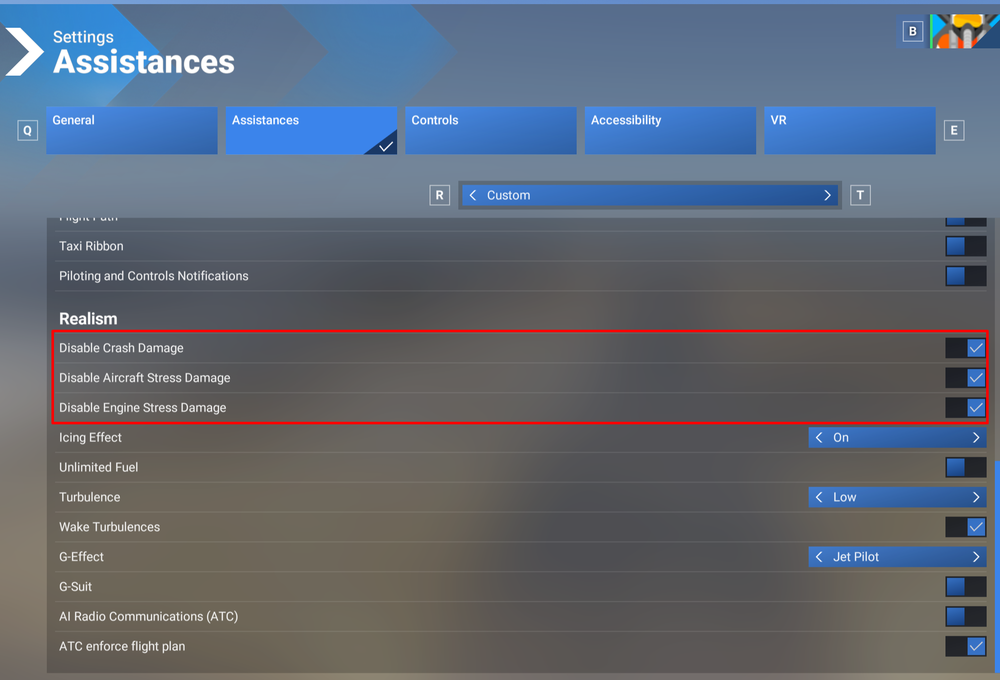
I would recommend disabling all 3 crash detection from Settings > Assistances. They usually cause conflict with 3rd party addon systems.

Thanks!
-
Hi @LNOSS
Could you share the PDF OFP of the affected route so we can try to repro on our end? Thanks!
-
1. The LTN-72 is not capable of triple-mixing IRL, so not simulated by design. The AP on this equipment configuration can be driven by INS-1 or INS-3 only. At the moment, only INS-1 drives the autopilot in the simulator. Team is investigating feasibility of coupling INS-3 in a future update.
2. Remote functionality is planned for a future update.
3. INS-Drift is simulated, and is a user-configurable option via the PFB Aircraft Settings (Note: Further refinement of drift-rate is in progress).
As MD82 mentioned above, there is no automatic position updating on the LTN-72 (manual excerpt attached). The manual position-updating procedure is explained starting Page 105 in the manual which can be obtained here. -
Thanks, forwarded to the team for further investigation.
-
Thanks, logged.
-
For the upcoming v1.0.1 update, we’ve made adjustments to the tint. Once the update is available on the Marketplace (expected around next week), we’d really appreciate it if you could try it out and let us know how it fairs.
On 4/1/2026 at 12:23 PM, wolfko said:I do not think that the tinted windows have any effect on the brightness within the cockpit.
Correct, the simulator doesn’t factor that in when determining interior brightness. The noticeable contrast between the interior and exterior is mainly due to how the sim currently handles eye adaptation, which is still a balancing limitation. The main workaround would be to brighten the cockpit textures, but that introduces much greater inaccuracies in the overall colors, so it’s a difficult trade-off.
Thanks!
-
Thanks for your reports.
For the upcoming v1.0.1 update, we’ve made several adjustments to textures aimed at improving overall FPS. Once the update is available on the Marketplace (expected around next week), we’d really appreciate it if you could try it out and let us know how it performs on your end.
-
 1
1
-
-
Hi @GACSavannah
Check that your simulator paths are set correctly in iniManager. Click your name at the top left, choose 'Sim Paths' from the menu. Use the 'Scan' button to set a path automatically or click the 'Folder' button to pick your community folder manually.
Then, restart iniManager and try again.
Alternatively, you can also grab third-party liveries from external sites like Flightsim.to for example.
Thanks!
-
Thank you for your suggestion. We are currently exploring the possibility of integrating your OFP flight plan for preview within the Enroute page of the PFB.
-
1
-
-
Hey,
Thanks for your suggestion. As the sim does not have support for this natively, it is quite an extensive undertaking that is beyond the original scope of this product line.
I won't promise to you that this is something we are going to do, however I understand the interest and take note of the suggestion for future development of this product line. Thanks!
-
Thanks for your suggestion. Will pass it along to the team for consideration.
-
Hey
Not as yet but will prod the team for one. We'll add it to the FAQ section once its ready.
Thanks for your patience meanwhile!
-
1
-
1
-
-
Hi, thanks for your report.
Team's already working on this for an update.
-
Ok thanks we'll have a look.
-
Thanks for the suggestion, we'll take it into consideration.
-
2
-
-
Thanks for the feedback, have taken note for the Art team to review.
-
Now that the TriStar is available, please try it in your sims and let us know what you think. The windows are rather well tinted per the references we have, but we'll await further feedback from you. Thanks!
-
Hi Xander
Thanks for your post, we'll take note of it for a future update.
Strictly speaking though, its not entirely wrong that there isn't one. While some cockpit configurations did have it, its not mandatory nor something that was found on all of them. I'll share an example here below.
In such instances you can still use the RA for reference (which is also provided for CAT 1 approaches on charts), though legally you still have to keep an eye out for the altimeter for the baro minimum.
In any case, I understand the need for one and as such have recorded your suggestion.
Thanks!
-
1
-
-
Download the official GSX Profiles for the iniBuilds TriStar Airliner via the links below
Standard Cabin Variant
- This profile is for Standard Cabin Variant without a lower-deck stairs entrance.
Cabin w/ Lounge Variant
- This profile is for the Cabin w/ Lounge Variant which has a lower-deck stairs entrance.
Installation
- Choose the Standard or Lounge Cabin profile .zip folder
- Extract the inibuilds-l1011 folder to %AppData%\Virtuali\Airplanes
QuoteNote: Due to GSX limitations, only one external profile can be loaded at a time for modular aircraft. Use only one profile at a time as needed. It is recommended to use the Standard Cabin profile primarily.
Uninstallation
- Delete the inibuilds-l1011 folder from %AppData%\Virtuali\Airplanes
-
The following section is intended to supplement the Simplified Procedures or in-simulator Checklist. General operating guidelines are provided along with speeds and power settings to be applied per flight phase.
Engine Start
- The port engine is started first, followed by the starboard engine.
- Select the port engine.
- Starter master switch: START
- Push and hold the STARTER button until the red light above illuminates, then let go of the switch.
- When the RPM reaches 1200 to 1500 RPM: HPC lever to the LOCK-OUT position.
- Repeat the procedure for the starboard engine.
After Start- Set the starter master switch to SAFE.
- Set flaps 16.5 for take-off.
Take-off-
Gently apply full power, which will be approximately 15,000 RPM.
Vr speed is between 80-110 KIAS depending on weight. - Rotate gently, especially at high weights because The F27 tail clearance is limited, allow the aircraft to get airborne on its own and avoid the temptation to increase the pitch further if the aircraft does not become airborne immediately. Continuous rotation can lead to a tail strike.
- Once airborne, adjust your pitch accordingly to maintain a V2 speed of 80-110 KIAS.
- Retract the gear , turn the Landing and Taxi Lights OFF and retract both Landing Lights.
- At 1,000 ft AGL lower the pitch of the aircraft to accelerate.
- Set climb power of 400 PSI torque, retract the flaps and set the HPC levers to the OPEN position.
- Establish a climb speed of 140 KIAS.
Climb
- Throughout the climb monitor the speed and adjust the vertical speed accordingly to maintain 140 KIAS.
-
Gently reduce the vertical speed and press ALT to engage altitude hold when your desired altitude is reached.
Note: If using the autopilot remember that there is no altitude preselector in this aircraft.
Cruise
A recommended level off technique for the F27 can enhance acceleration upon reaching cruise altitude. Rather than levelling off precisely at the selected altitude, it is advisable to momentarily overshoot by approximately 200 feet.
By maintaining climb power during this phase and then descending back to the the target altitude, this 200-foot power-on descent significantly aids in achieving the desired cruise speed of approximately 180-200 KIAS.
Descent
Set power as required to maintain the current cruising speed, targeting a vertical speed of 1,000 to -1,500 FPM.
Approach and Landing
-
Extend the flaps when below V FE (144 KIAS) and extend the gear below V LO (168 KIAS).
Note: 168 KIAS is also the maximum speed for landing lights extension. - Set the HPC levers to LOCK OUT.
- The initial approach speed is 110 KIAS, reducing to a Target Threshold Speed between 80-100 KIAS, depending on weight.
Go Around
- Apply full power and select Flaps 1 6.5 while selecting an initial pitch attitude of 10 degrees.
- Retract the gear when a positive rate of climb is achieved.
- Continue as per the Take -off section, accelerating at 1,000 ft AGL.
-
The Microsoft / IniBuilds F27 is equipped with a dedicated DME Receiver that can be tuned via the Lower Overhead Panel to display DME Unit readouts on the main instrument panel.
DME Radio Tuning
The DME Receiver is tuned via the the knobs on the Lower Overhead Panel. The active frequency is denoted with a DME decal above the frequency display window on the right.
DME Unit Operation
The DME Unit on the Main Instrument Panel has a knob that toggles the digital display to show three distinct, real-time navigational data points relative to a DME station:
- DME Miles (NM): The straight-line "slant range" distance from the aircraft to the ground station in nautical miles. This is always shown on the top display.
- KTS (Groundspeed): The speed of the aircraft moving directly toward or away from the station, measured in knots. This is shown on the bottom display when the knob is set to KTS.
- MIN (Time-to-Station): The estimated time in minutes to reach the DME station, provided the current ground speed and direct course are maintained. This is shown on the bottom display when the knob is set to MIN.
-
The Microsoft / IniBuilds F27 is equipped with 3x COM radios, 2x NAV Receivers, 1x DME Receiver, 2x ADF Receivers. The COM1/NAV1 radios are always tuned via your chosen GPS Unit, while all other radios are controlled via the Lower Overhead Panel.
GPS Unit
The COM1/NAV1 are always controlled via the GPS unit controls. You dial the standby frequency and then swap it to active.
On the GNS 430, press the PUSH C/V button to toggle between COM1 and NAV1 radio tuning functions.
On the PMS / TDS GTN 650, press the right knob to swap between COM1 and NAV1 radio tuning functions.
QuoteNote: You can switch between the various GPS units via the EFB Options page. For more information see the How To - Swap GPS Units guide.
Lower Overhead Panel (Radio Panel)
The COM2/3, NAV2, DME and ADF1/2 radios are tuned via the controls on the lower overhead panel.
- ADF1
- Captain Audio Panel
- COM2/3
- NAV2 & DME
- Transponder
- ADF2
-
First Officer Audio Panel
QuoteNote: The COM2/3 and NAV2/DME do not have a standby frequency selection. The tuned frequency is directly the active one.
-
F-27 Manual
in FAQs
-
1
-



HSI true north when in INS mode
in Systems
Posted
That is actually correct per the system documentation we have available, and a system quirk we have modelled. The HSI Distance/Time readouts are only driven by the INS computers, as such can only show data from it. For radio navigation you need to use the DME Readout from the RMI gauge to the left of it which does take data from the NAV and ILS receivers.