
mattY
-
Posts
386 -
Joined
-
Last visited
-
Days Won
128
10 Followers


.thumb.jpg.898f2ff3ee0fd2f637c46c4d46ec1663.jpg)

mattY's Achievements
1.1k
Reputation
-
v1.1.0 of iniBuilds Manchester (EGCC) for MSFS 2024 has been released. This update addresses taxiway layouts to match the Feb 26 charts, including E extension connectivity, L path refinements, updated signage, and adjusted stop markings from E8–E3. Improved ground operations with working hold short light bars, refined terrain heights, added red barrier lighting on closed taxiways, and an updated GSX profile. This update can be downloaded via the iniManager. v1.1.0 - Taxiway layout changes match Feb 26 chart - E extension is now connected per Feb 26 chart. - Added/adjusted all stop markings from E8 to E3 - Changes to L path - Taxi signs updated - Hold short light bars should now turn off as you approach. - Major height/terraforming changes. Should now only be slight difference between runway and apron heights. - Added red lights to barriers across closed taxiways. - Updated GSX profile
-
Flightsim Dispatch is a fantastic route planning tool that gives you access to millions of real-world flights, including historical airline operations from the 1970s through to today. For the TriStar Airliner, this is especially valuable, as much of the aircraft’s character comes from flying authentic routes used by airlines like British Airways, TWA, Delta, and Eastern. Getting started is simple. Download the tool from flightsimdispatch.net, extract the files, and launch the application. Once open, begin by entering a departure airport ICAO (for example, EGLL for London Heathrow). From there, you can refine your search to better match TriStar operations by applying filters such as aircraft type (L1011/TriStar), airline, flight duration, and most importantly, a year range. For the most authentic experience, set the year between the 1970s and 1990s, which reflects the peak operational period of the TriStar. Once those filters are in place, click Refresh Table to generate the results. Flightsim Dispatch will then display a list of real-world flights matching your criteria, including the departure and arrival airports, airline, aircraft type, and route length. Scroll through the list and choose a flight that suits the kind of session you want, whether that is a shorter regional sector or a longer intercontinental route.

-
👉Getting Started Q. How do I load the aircraft quickly? A. The fastest way to get the aircraft ready is by using the Flight Engineer Autocomplete feature within the PFB (Paper Flight Bag). You can use this feature for all essential phases of flight to ensure the correct setup. This allows you to: Instantly configure the aircraft from cold & dark Automatically set up electrical, pneumatic, fuel, and engine systems Skip complex manual flows if you prefer a quicker start You can also: Run full autocomplete Or selectively enable specific systems for a semi-manual setup Q. What checklist mode should I use? A. The aircraft provides two checklist modes: Standard Mode Simplified procedures Skips deeper system tests Best for casual flying or quicker setups Expert Mode Full procedural depth Includes realistic system checks Designed for maximum realism Recommendation: Start with Standard, then transition to Expert as you become more comfortable. Q. How do I import a SimBrief flight plan? A. To import your SimBrief route: Open the PFB → OFP page Enter or sync your SimBrief profile Press SEND TO INS This will: Automatically load your route into the INS Use the batch loading system (9 waypoints at a time) Eliminate the need for manual waypoint entry Important: The INS must be properly aligned before navigation will function correctly. Q. Why is INS alignment taking so long? A. The alignment time depends on your selected realism setting: Instant → Immediate alignment Fast → ~5 minutes Realistic (Slow) → ~17 minutes If alignment seems stuck: Ensure aircraft is completely stationary Verify valid position entry Confirm AC + DC power availability Q: Why can I hear a warning bell when I advance throttles on takeoff? A: This is the Takeoff Configuration Warning, a safety system designed to alert you if the aircraft is not correctly configured for takeoff. The warning will trigger when two or more thrust levers are advanced beyond approximately 50%, indicating the start of a takeoff roll, while required configuration parameters are not met. The most common causes are: Stabilizer trim not set within the takeoff range (white band on the trim indicator) Flap setting outside the valid takeoff range (must be between 10° and 24°) If either of these conditions is not satisfied, the aircraft will continuously sound the warning to prevent an unsafe departure. To resolve the warning: Check and set the trim so it falls within the marked takeoff band Ensure flaps are correctly set within the approved range Reconfirm configuration before advancing thrust again This behaviour closely replicates the real-world TriStar, where proper takeoff configuration is critical. The system acts as a final safeguard, ensuring the aircraft is correctly set up before committing to the takeoff roll. ✈️Autopilot & Flight Q. What is the difference between CWS and CMD modes? A. CWS (Control Wheel Steering) Holds the current attitude You manually position the aircraft The autopilot maintains that attitude CMD (Command Mode) Follows selected autopilot modes (Heading, INS, VNAV, etc.) Fully automated flight control In short: CWS = “hold what I set” CMD = “follow the system” Q. Why is my aircraft not following modes properly? A. You are most likely in CWS mode instead of CMD. In CWS: The aircraft ignores navigation modes It only holds current pitch/roll Fix: Switch to CMD mode Re-engage your desired mode (INS / HDG / etc.) Q. Why did my autothrottle disconnect? A. Common causes include: Turbulence mode enabled Certain pitch modes overriding thrust logic Manual throttle input Mode transitions within AFCS Always verify: ATS is ON THR MGT mode active (when using PMS) 🛬Landing & Approach Q. How does Autoland work? A. The TriStar supports CAT IIIB Autoland, allowing: Fully automated approach Automatic flare Automatic rollout This enables landings in: Very low visibility Near zero decision height conditions Ensure that the proper ILS setup and associated systems have been configured as required. Q. Why are my spoilers not deploying? A. Check the following: Flaps set above 30° DLC / AGS armed No manual override active If any of these are missing, automatic deployment will not occur. Q. What is DLC? A. Direct Lift Control (DLC) allows the aircraft to: Control descent using spoilers instead of pitch Maintain a more stable glidepath Improve landing precision It is primarily used during approach and landing. ⛽Fuel, Electrical & Other Systems Q. Do I need to manage fuel manually? A. Yes - the TriStar fuel system requires active management. Typical flow: Takeoff: Tank-to-engine Cruise: Balance tanks Approach: Return to tank-to-engine Proper management ensures: Stability Correct CG Engine feed reliability Q. Why are center tanks not feeding engines? A. Center tanks do not feed engines directly. They must first be transferred into main tanks. Only then can fuel be supplied to engines. Q. Why is wing anti-ice not working on the ground? A. This is intentional and realistic. Wing anti-ice is disabled on the ground to prevent: Overheating Structural damage Q. What do DUCT OVHT warnings mean? A. This indicates overheating in the pneumatic system. Common causes: Incorrect bleed configuration Excessive air pressure Improper system setup To rectify any potential issue, review bleed air and pack configuration, referring to the checklists if necessary.
-
- 1
-

-
Before you fly, you must set your Zero Fuel Weight (ZFW) and Fuel Load (FUEL) via the Paper Flight Bag (PFB) - Loadsheet Page. You can set these weights manually or import them through Simbrief for instant loading onto the aircraft. (Click to enlarge image) Select either SimBrief Import, which will automatically populate all values as provided by your OFP. If you would like to manually set these weights, you can do so by either using the Fuel/Cargo/PAX sliders by clicking and dragging these to the desired position, or you can manually input values in each box on the right hand side of the page. Once you have confirmed the value, click "Load" which will save your value.
-
TriStar SimBrief Profiles Regular Variant Click the image to add the airframe to your SimBrief! POD Variant Click the image to add the airframe to your SimBrief!
-
Attached below is the Aircraft Manual for the iniBuilds TriStar Airliner for your reference. Current Version: 1.0 iniBuilds_TriStarAirlinerManual.pdf
-
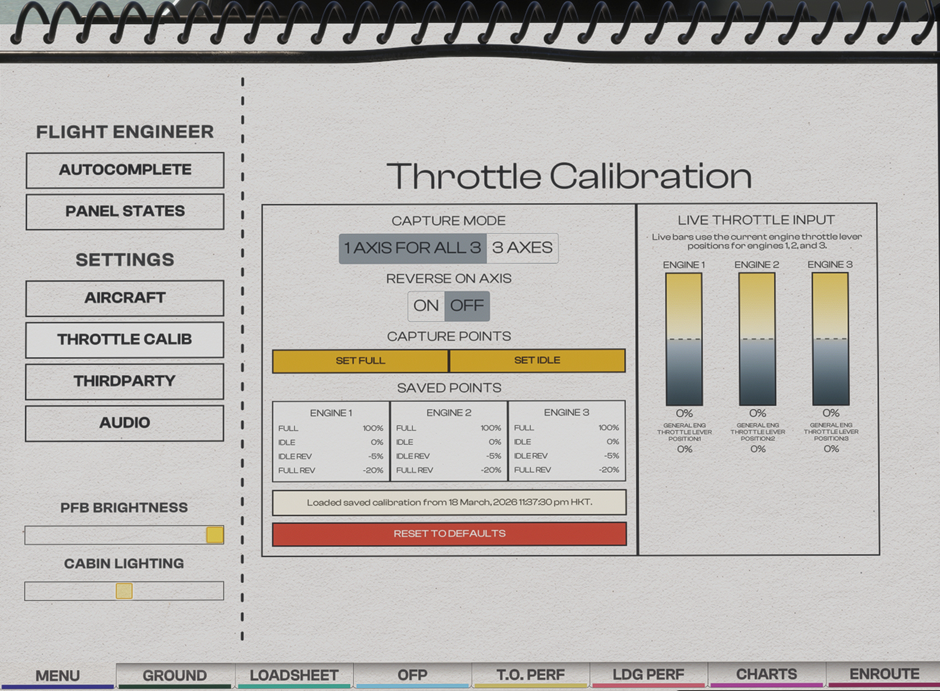
Throttle Calibration Page (PFB) Choose the number of axes that matches your controller setup, then calibrate accordingly Throttle Calibration Process Typically the throttle calibration is done in the following order Ensure that Throttle Axis or Throttle Axis 1 to 3 are assigned in the MSFS Control settings. Set desired REVERSERS ON AXIS option Set desired CAPTURE MODE option Move your hardware throttle axis to the capture point you want to define (e.g. REVERSE/IDLE/FULL) Click the SET [POSITION] button on the PFB to define the current position to the position chosen Repeat Steps 4 to 5 for each desired capture point. Note: If you have issues with the throttle axis, please note that the throttle axis should not be configured using the option labeled "(0 to 100%)" in Settings > Controls.
-
The TriStar’s Performance Management System (PMS) provides real-time calculations for thrust settings, fuel predictions, and vertical flight profiles across all phases of flight. Unlike modern FMCs, the PMS operates through a structured page system, requiring manual data entry and validation to generate accurate performance outputs. (Click to enlarge image) Data Entry – General Procedure Navigate to desired page Press softkey on left corresponding to line to be modified Verify field clears and INSERT button illuminates Enter value using right keypad (observe correct format, decimals, signs) Verify entered value Press INSERT (light extinguishes) Use CLR to cancel / start over if needed Note: Entering an empty value usually exits entry mode without saving. Step 1 – TAKEOFF Page First page displayed after pressing PERF MGT. Enter / verify (values often persist from previous flight – always check): GMT – Zulu time (HHMM) at initialization - Should be modified for estimated takeoff time EPR – Computed from pressure altitude (after all parameters are inserted) PR ALT – sensed by ADCs (not entered) GW – Gross weight in thousands of lb (round up to nearest 1,000 lb) FUEL – Fuel weight in thousands of lb (decimal shown automatically) SAT – Static Air Temperature (°C); enter sign first if negative Once all values are entered with valid values the PMS will calculated the optimum takeoff EPR value and will display it in the EPR line Note: SAT valid range for EPR calc is –20 °C to +54 °C. Out-of-range values are clamped. Fuel value is limited to three digits, so you can enter decimals if the value is below 100. E.G. 85.700 would be 85.7. Otherwise, you must round up the value. For example, 155.200 pounds would be rounded up to 1560. Step 2 – FLIGHT SETUP Page Navigate using AFT / FWD keys Initial performance modes (most economical and only current availables modes): CLIMB: OPTIMUM / 250 kt CRUISE: 3 ENG CRZ STD DESCENT: OPTIMUM / 250 kt Enter BOD (Bottom of Descent) data: BOD DIS – distance to descent point (NM) BOD ALT – altitude at BOD (ft) BOD SPD – speed at BOD (kt) Recommendation: Update BOD values enroute after INS is aligned for better accuracy. Step 3 – TAXI & TAKEOFF (Update GW) Return to TAKEOFF page Update GW (subtract taxi fuel burn) Leave page open during takeoff and initial climb for monitoring Step 4 – CLIMB Page Automatically displayed after takeoff or by selecting first line on FLIGHT SETUP. Displayed values include: CLB – IAS targets (below 10,000 ft / intermediate / high-alt Mach×100) EPR – min & max ALT – selected cruise altitude (FL) – must be entered OPT – computed optimum cruise altitude TOC – distance & time to Top of Climb CLB MANUAL ? - Erase speed portion on CLB line and allows to change it, then the PMS will adjust climb rate to match that airspeed using the OPT EPR value. SAT - Static air temperature in C degrees TAS - True air speed in knots Step 5 – CRUISE Page Displayed values include: CRZ - Mach and IAS target - opens CRUISE sub-page FUEL REM - Remaining fuel in thousands of pounds ALT - Selected cruise altitude OPT - Optimum cruise altitude STEP - TBD - opens STEP DATA sub-page TOD - DIstance in NM and Time zulu to the top of descent - opens TOD sub-page SAT - Static air temperature in C degrees TAS - True air speed in knots Engagement procedure (especially after VNAV/TM interruption): Set AFCS pitch mode to ALT HOLD Press PERF MGT → select CRUISE page Press TM button (light on) + set ATS to ON Verify AFCS mode changes to THR MGT Adjust EPR manually if necessary Confirm Mach target is maintained Typical values (STD cruise): 0.830 M / 285 KIAS CRUISE sub-page (press CRZ line): 3 ENG CRZ STD → 0.830 / 285 3 ENG CRZ LRC → long-range cruise (see tables – pending) 3 ENG MANUAL → allows direct Mach/IAS entry STEP DATA sub-page: WIND - Current wind velocity and direction CLB - Distance in NM and Time zulu at the beginning of the step-climb to STEP ALT STEP ALT - Step climb altitude in 4000ft increments FUEL SAVE - Total fuel save or lost by climbing to the STEP ALT compared to present altitude NEW ALT SAT - Assumed SAT at STEP ALT using non-standard ISA values SAT - Static air temperatures in C degrees TAS - True air speed in knots TOD sub page: In the CRUISE page, press TOD line and the DES BOD page will be displayed with the following information: DES - Mach, airspeed above 10000ft and airspeed below 10000ft BOD - Distance in NM and Time zulu to BOD BOD ALT - Desired altitude in ft at BOD BOD SPD - Desired speed (IAS) in knots at BOD TOD - Distance in NM and Time zulu to reach TOD SAT - Static air temperature in C degrees TAS - True air speed in knots STEP 6 - DESCENT To start a descend, the operator should follow the next procedure: Select the desired altitude on the glareshield panel On the PMS go to the CRUISE page and update the ALT value to this new altitude and press insert Press VNAV mode and check ATS and TM are engaged too If the descent is started at any moment of the flight up to 10 minutes before TOD, the following page will be displayed: DES - Descent profile with Mach and flight level ALT - Selected altitude and optimum cruise altitude SAT - Static air temperature TAS - True air speed Once the aircraft reaches the desired altitude, it will resume the cruise mode and CRUISE page will be displayed If the descent is started within 10 minutes before TOD, the page will be slightly adjusted to show "DES OPT (DIST)NM": Page title - Distance in NM (could be positive or negative including the (-) sign) where the aircraft will reach BOD altitude relative to the its waypoint position (could be before or after the actual BOD) DES - Descent profile with Mach, airspeed above 10000ft and airspeed below 10000ft BOD - Distance in NM and Time zulu to BOD BOD ALT - Desired BOD altitude BOD SPD - Desired BOD speed SAT - Static air temperature in C degrees TAS - True air speed in knots STEP 7 - Landing After descent phase and once BOD altitude is reached, the LANDING DATA page is displayed: VTH - Indicated airspeed at threshold GA EPR - Go-Around calculated EPR PR ALT - Current pressure altitude GW - Computed gross weight GS - Ground speed FUEL - Computed remaining fuel SAT - Static air temperature in C degrees TAS - True air speed in knots Operation Notes: BOD DIS is the distance between the aircraft position at the moment the data is entered and the point where the user intends to complete the descent. It is strongly recommended that this point be the last waypoint of the flight plan entered in the INS, in order to obtain the along-route distance between the current aircraft position and the BOD. BOD ALT is entered in feet, not in Flight Levels (FL). The value must be entered directly; for example, an altitude of 3,000 feet must be entered as 3000. The BOD line on the DES BOD OPT page displays the distance and estimated time of arrival at the BOD, calculated based on groundspeed and the distance traveled as a function of groundspeed. It is important to note that if BOD DIS is entered incorrectly, the BOD estimates will not be coherent, since all horizontal and vertical VNAV profile calculations are based on this distance. During OPT (standard) descent, an airspeed setpoint of 250 knots must be used. Each time a BOD value is entered or modified (DIS, ALT, or SPD), the system resets the distance-traveled estimation. This is done to recalculate BOD DIS and ensure that all estimates remain accurate. On the CLB OPTIMUM, 3ENG CRUISE STD, and ENROUTE DESCENT pages, the ALT value can be read and updated. This value is expressed in Flight Levels (FL) and is used by the system to calculate the difference between the current altitude and the BOD altitude. The system dynamically calculates the required descent distance, descent time, and required vertical speed, using a dynamic method similar to the 1:4 rule. Considering the previous point, if the distance required for the descent maneuver exceeds the BOD distance, the system will not be able to correctly compute the descent profiles. To verify this condition, it is recommended to check and compare BOD and TOD, ensuring that a TOD distance exists and that the distance to BOD is greater. The difference between these two values represents the distance allocated for the descent (this applies only if the TOD distance is greater than zero). (Click to enlarge image) Important Notes for Descent: To initiate a correctly computed descent profile, you must keep the cruise ALT value unchanged (the value entered on the CLB or CRZ page). The PMS calculates the required descent altitude difference (and therefore the TOD/BOD distances and required VS) based exclusively on the difference between cruise ALT and BOD ALT. If you manually change the ALT value to match the BOD ALT (or set both to the same altitude), the system will detect zero altitude difference. As a result: Descent distance becomes 0 The required descent VS becomes invalid The TOD and BOD predictions will be incorrect or show as zero Recommendation: Leave the cruise ALT exactly as it was set during climb/cruise planning. Only enter or modify the BOD ALT when you want to start the descent profile. The cruise ALT must remain the original reference altitude for the calculation to work correctly.
-
To expand operational flexibility and support modern navigation techniques alongside the inertial navigation system (INS), the autopilot (AFCS) now includes a GPS mode. This mode integrates a conventional GPS unit while preserving the familiar AFCS philosophy of button cycling to engage/disengage flight modes (similar to pitch modes). GPS mode is activated using the VOR button on the AFCS panel. The system automatically selects the navigation source based on the current state of the GPS CDI indicator. (Click to enlarge image) To engage GPS mode Verify GPS CDI source Ensure the GPS unit displays "GPS" in the CDI area (not "VLOC" or another source). If necessary, press the CDI button on the GPS unit repeatedly until "GPS" appears. Engage AFCS mode Press the VOR button on the AFCS panel. Confirm the VOR button light illuminates (indicating mode armed/engaged). Confirm guidance Verify that the captain's HSI and Flight Director (FD) display the desired GPS-derived course, deviation, and steering commands. Important notes GPS mode is available if the NAVIGATION OPTIONS on the EFB are set to GPS only or INS+GPS VOR Mode is not dynamic Once engaged, the AFCS locks onto the navigation source present at the moment the VOR button is pressed. If you later change the GPS CDI source (e.g., from "GPS" to "VLOC"), the autopilot will not automatically switch. To update the mode: Press the VOR button again to disengage the current mode. Re-press the VOR button to re-engage using the new source. This maintains the consistent AFCS philosophy of cycling buttons to change or refresh modes (as seen in pitch hold, vertical speed, etc.). Flight plan import You may import flight plans from the simulator's Flight Planner directly into the GPS unit. In the EFB (Electronic Flight Bag), select your route and press SEND TO AVIONICS. Display limitations All GPS-derived data (course, crosstrack deviation, TO/FROM indication, etc.) appear exclusively on the captain's HSI. The first officer's instruments are not driven by GPS mode in this configuration. This hybrid capability allows seamless use of satellite-based navigation while retaining full INS backup and the original AFCS operational feel. Always cross-check the active navigation source on the GPS unit before engaging or changing modes. Monitor the HSI closely during transitions. For more information on other Navigation methods, please refer to How to - INS Setup, Operation & Procedures & How to - Simbrief Integration
-
The TriStar features an integrated SimBrief Navigation Tool, designed to streamline route management while preserving the authentic behaviour of the aircraft’s Inertial Navigation System (INS). Unlike modern flight management systems, the TriStar’s INS is limited to 9 waypoints at a time. To bridge this limitation while maintaining realism, the Navigation Tool introduces a batch loading system, allowing full SimBrief flight plans to be used seamlessly without altering the original INS logic. (Click to enlarge image) This system enables pilots to import complete routes directly from SimBrief, with the Navigation Tool intelligently managing waypoint loading in the background. From the cockpit perspective, the experience remains true to the real aircraft, while significantly reducing workload for longer routes. Automatic Batch Loading Procedure (Default Mode) When the user presses SEND TO INS from the PFB , the system performs the following steps: All incoming waypoints are collected and stored in a local variable (the complete imported route list). The first 9 waypoints are automatically loaded into the INS (positions INS 1 through INS 9). During flight, the system continuously monitors aircraft progress: When the aircraft passes or sequences waypoint 9 (or the next waypoint is manually selected), The INS automatically cycles back from waypoint 9 to waypoint 1. At that exact moment, the next batch of 9 waypoints (10–18, then 19–27, etc.) is loaded into the INS. This process repeats transparently until all imported waypoints have been used. Note: You must follow the INS alignment process properly in order to use the imported waypoints From the pilot’s perspective: The INS always displays only 9 waypoints — exactly as in the real aircraft. Waypoint identifiers/names match exactly those imported (e.g., SKBO, BOG01, SB15, etc.). No manual waypoint insertion is required during normal cruise in automatic mode. Batch transitions are automatic and no action is needed by the pilot. For now, the map only displays the route using the active INS waypoints, so seeing an “incomplete” route line is expected. The line will continue to update as additional batches of waypoints are processed. Important note: Pilots retain full ability to manually modify, insert, or delete waypoints at any time using the standard INS procedures (numeric keypad, position selector, etc.). Manual Batch Selection (Batch Selector) - Feature Coming Soon If you wish to manually choose which group of waypoints is currently loaded into the INS: Locate the BATCH selector on the NAV TOOL interface Select the desired batch number: Batch 1 → waypoints 1–9 Batch 2 → waypoints 10–18 Batch 3 → waypoints 19–27 and so on The INS will immediately update to display the selected batch of 9 waypoints. This manual control is particularly useful when: wanting to go direct to a distant waypoint in the flight plan. Reviewing or editing a specific batch without waiting for automatic cycling. Reloading an earlier batch in case of an error or change in routing. Waypoint Naming and Display The INS always shows only 9 positions (INS1 to INS9). The waypoint names/identifiers displayed in the INS are identical to those imported from SimBrief (e.g., BOG, MDE, CLO, SKRG, etc.). Latitude and longitude are presented in the standard INS format (N/S ddmm.m – E/W dddmm.m). Summary of Key Benefits Maintains full realism of the original INS panel (maximum 9 visible waypoints). Supports very long flight plans without constant manual intervention. Provides automatic, fluid transitions between batches during cruise. Offers complete manual override via the Batch Selector when needed. Fully compatible with standard manual INS modifications at any time. Operational recommendation: Use automatic batch loading for most long-haul flights. Switch to manual Batch Selector only when you need to jump sections, preview data, or make targeted adjustments. For more information on other Navigation methods, please refer to How to - GPS Navigation (INS + GPS) & How to - INS Setup, Operation & Procedures
-
The system initializes with three independent INS units. During power-up, the sensors stabilize and the system establishes initial attitude in ATT mode. Once the attitude is valid and aligned, navigation initialization and alignment with the aircraft’s actual position must be performed. This full alignment process takes approximately 17 minutes. Important: Alignment must be performed with the aircraft on the ground and engines off. Any movement during alignment introduces position offset errors. The artificial horizon can use either the vacuum system or the INS attitude reference. It is strongly recommended to keep the INS attitude source active as a backup. INS Initialization Verify that the DC Standard Bus or AC Standard Bus is powered. Check relevant circuit breakers are in. Set INS Mode Selector to STBY. Note: While the displays are powered by DC STBY BUS (battery or DC ESS BUS), the inertial platform itself requires AC ESS BUS power (normally fed from AC BUS 3 or via AC ESS BUS SELECTOR). Set Display Selector to POS. Verify display matches the expected format (example shows “72” or “73” – in our case “72”). (Click to enlarge image) At this point the INS units are powered and initialized avionics-wise, but navigation is not yet active. Display Test Should be performed in STBY, ALIGN (preferably avoid during alignment), or NAV modes. Set Display Selector to TEST. All characters, digits (including HSI), and warning indications must illuminate fully. (Click to enlarge image) Navigation Initialization & Alignment Alignment starts when Mode Selector is moved to ALIGN (after entering present position). The alignment timer counts down from ~17 minutes (DSR TK / STS page display shows accumulator from 90 → 01 on the right side). Present Position Entry Procedure The Present Position Entry is the known coordinate where the aircraft is currently located. It must be derived from a valid and accurate source to ensure reliable data for system initialization. During the initialization process (typically on the ground), this is usually the gate or airport coordinates obtained from the airport chart, parking stand diagram, or airport reference point in the navigation database. In mid-flight (or when reinitializing due to loss of position), it can be a calculated intersection of two VOR-DME radials, visual references, or any other reliable navaid or method where the aircraft's position is already known with high confidence. Key Guidelines: Always use the most accurate position available (e.g., GPS if available, followed by reference airport/gate, last known position, or manual entry from charts). Verify the entered position against multiple sources (e.g., airport chart, or navaid cross-check) to avoid errors that could affect IRS alignment or navigation accuracy. An incorrect or unreasonable present position entry may cause serious navigation drifts and errors that could lead to dangerous loss of situational awareness. Procedure: Mode Selector → STBY Display Selector → POS Enter latitude: Press N or S Verify “N” / “S” appears on left display and INSERT button illuminates Enter degrees/minutes/decimal using numeric keypad (DDMM.S - e.g. N32477 which is N32°47.7’) Press INSERT Enter longitude (same procedure): Use E or W Longitude has one extra digit (max 180°) (DDDMM.S - e.g. W072234 which is W072°23.4’) INSERT light should remain on after both lat & lon are entered To correct: press CLEAR and re-enter. Move Mode Selector to ALIGN to start alignment process. Notes on coordinates: IMPORTANT: The initial position is the point where the system ties the four-dimensional navigation frame to the NED (north-east-down) frame and is where the aircraft will be placed on it - any mistake during this process (like unaccurate or mistaken data) could lead to dangerous navigation estimations Format: degrees, minutes, decimal minutes (no negative signs – use N/S, E/W) Latitude limited to 90°, longitude to 180° - if input goes beyond this limit the system will normalize it and calculate unexpected results. A valid coordinate must have both a latitude or longitude component different than 00”00.0 or 000”00.0 respectively. Waypoint Entry Set AUTO/MAN/RMT switch to AUTO or MAN Display Selector → WPT WPT Selector → desired waypoint number (1–9) Enter lat/lon same way as present position. INSERT light extinguishes after each coordinate is accepted (unlike POS mode). Waypoints must be entered sequentially (1→2→3…); gaps (e.g. 1 & 3 but not 2) will cause navigation discontinuities. Alignment Monitoring & Status Codes Set Display Selector to DSR TK/STS to monitor alignment progress. Alignment status starts at 90 and counts down to 01. (Click to enlarge image) Alignment Requirements (must all be true): Aircraft on ground Aircraft completely static (no movement) AC power available (AC ESS BUS or AC STBY BUS) DC power available (DC STBY BUS) Valid present position entered (not 0° 0.0') Critical notes: Once aligned (01) and switched to NAV, do NOT move mode selector out of NAV unless on ground and static → otherwise alignment is lost permanently until next ground static alignment. Loss of AC/DC power or movement during alignment will also force full restart on ground. (Click to enlarge image) Initial Desired Track (Leg 0–X) Must be set after at least one waypoint is entered and alignment reaches 01, otherwise it wont let enter any TK. Ensure no active data entry is in progress. Press TK CHG button (both TK CHG and INSERT lights illuminate). Enter 0 + waypoint number (e.g. 0-1 to fly direct to WP1 from present position). Verify display shows 0–X. Press INSERT → lights extinguish if valid. Invalid entries (0-0, non-existent WP) cause 0-0 and lights remain on. NOTE: You can only set the Initial Desired Track once for navigation initialization or to restart navigation once you reach latest waypoint on previous flight plan. Waypoint / Leg Change (TK CHG) After navigation is active, change active leg anytime: Press TK CHG Check both TK CHG and INSERT lights are illuminate Enter FROM–TO (e.g. 3-5 or 0-7 for direct-to WP7) Press INSERT if valid, otherwise press CLEAR and repeat the process Check both lights extinguish Behavior: 0–X → Direct-to waypoint X from present position A–B → Intercept A→B leg at ~30° angle If significantly off-track and far from leg, system may fly direct to B until intercept conditions are met Small overshoot possible at high speeds (>300 kt) ATT REF Mode Provides pitch & roll reference independent of full navigation. Gyro valid after: Mode = ALIGN, NAV or ATT REF >5 min powered from cold start, or >3 min if recently powered ATT REF mode disables navigation (status → 90); recovery only possible on ground, static. If mode selector moved to OFF in flight → attitude reference corrupted until next ground static realignment. RMT (Remote) TK CHG Calculations While in RMT, TK CHG can be used to query distances without affecting active navigation. A–B → great-circle distance between two waypoints 0–X → along-route distance from present position to waypoint X (passing all intermediate WPs) X–0 → direct distance from present position to waypoint X Note: Below 100 kt groundspeed, system assumes 512 kt for time calculations. Cross-Track (XTK) / Offset Mode Accessed via XTK/TKE selector position. Creating an offset parallel to active leg: Valid leg must be active Set selector to XTK/TKE Press 1 (left field clears, INSERT illuminates) Press L7 or R9 → L / R appears Enter offset distance in NM (one decimal) e.g. R 34 → 3.4 NM right Press INSERT Display shows: Left: current cross-track distance to original leg Right: track angle error (max ~30° during capture) Offset cancels when: Enter zero / blank offset (e.g. press 1 → INSERT) Waypoint transition occurs New leg selected via TK CHG Any waypoint coordinate changed WAYPOINT SEQUENCING (Click to enlarge image) ALERT light illuminates when time to your next waypoint is below 2 minutes and flashes when you are 30 seconds to reach it, then it extinguishes. WARN light illuminates for 30 seconds after the system automatically switches from last waypoint to the first one as per normal waypoint cycling whether is 9-1 or X-1. You could notice that in some cases you won't be able to see the flashing ALERT light depending on the track change angle, for closed angles the track change threshold starts a bit earlier than 30 seconds. Note that INS ETA are in decimals of seconds, so 30 seconds would be 0.5 minutes. The system automatically advances to the next valid waypoint (1 to 9) when the transition threshold is reached. If the next waypoint does not exist or is invalid: If ≥ 3 valid waypoints are present in the current batch → automatically cycles to waypoint 1 (leg: last → 1). If 1 or 2 valid waypoints only → continues straight ahead indefinitely on the current track (no cycle). When reaching waypoint 9 and a next batch is available (when using waypoints import): Current waypoint 9 is saved. Next batch is loaded. Saved (old) waypoint 9 is restored → leg changes to 9 → 1 (overlap transition). After passing the new waypoint 1 and advancing (e.g. to waypoint 2), the new batch’s original waypoint 9 is restored. For more information on other Navigation methods, please refer to How to - GPS Navigation (INS + GPS) & How to - Simbrief Integration
-
 v1.0.3 of iniBuilds Dallas Fort Worth (KDFW) for MSFS 2024 has been released. This is a small update to address an issue with a runway dirt surface issue. This update can be downloaded via the iniManager. v1.0.3 - Fix runway dirt surface issue
 -
iniBuilds A350 Airliner V1.2.4 Update 🚀 v1.2.4 for the iniBuilds A350 Airliner is now available. This update resolves several key flight logic and navigation issues, including incorrect descent mode behaviour, overlapping step climbs on the position report page, and inaccurate fuel burn predictions. Fixes have also been made to premature auto-rotation, incorrect DME/VOR display, and unrealistic ADS-B vertical speed readings, alongside refined roll sensitivity for improved handling. An EFB update also introduces an in-flight maintenance override, allowing users to repair items during flight. This update can be downloaded via the iniManager. ____________________________________________________________V1.2.4 SYSTEMS ⚙️ FIXED Aircraft had inadvertently entered descent mode and it was impossible to re-enter climb mode FIXED Having multiple planned step climbs causes them all to overlap on the position report page FIXED Fuel burn predictions in MCDU are inaccurate FIXED Aircraft auto rotating prior to v1 FIXED DMEs display as VORs FIXED ADS-B readout shows unrealistically high vertical speeds FIXED Adjusted roll axis sensitivity based on user feedback. EFB📱 ADDED Override for maintenance items to be repaired in-flight
-
- 5
-
-

-

-
iniBuilds A350 Airliner V1.2.3 Update 🚀 v1.2.3 for the iniBuilds A350 Airliner is now available. This update focuses on a broad range of systems stability, navigation logic, and usability refinements across the aircraft. Numerous fixes have been implemented within the FMGS, flight planning, TCAS behaviour, performance calculations, and display formatting, alongside improvements to flight director behaviour, thrust logic, and waypoint management. Additional refinements have also been made to the ECAM, HUD behaviour, and various pages across the flight deck displays, improving accuracy and consistency during normal operations. The update is rounded out with art and sound improvements, including refined RA callouts, improved exterior audio balance, cockpit and cabin sound tuning, and adjustments to cabin lighting and visual behaviour. This update can be downloaded via the iniManager. ____________________________________________________________V1.2.3 SYSTEMS ⚙️ FIXED WASM crash after selecting STAR FIXED TCAS triggering from aircraft which are non factors FIXED Pitch jerkiness when passing through 10° with constant stick input FIXED Manually entered CRS shows in small font in the A350 FIXED TCAS returns all defined as "HEAVY" FIXED D-ATIS not timing out FIXED Inaccurate colours on SEC/PERF/APPR page FIXED OPT FL should be shown every 500ft FIXED Waypoint revision logic on Active, Temporary, and Wind pages FIXED Position/Report page formatting issues FIXED Flightplan STEP ALTs page logic/format FIXED Time marker should be in chronological order FIXED Font & sizing issues on PERF approach page FIXED Key input not masked anymore in simconnect FIXED Loadsheet formatting FIXED Flight Director sensitivity FIXED PDC response not being received from HOPPIE connections FIXED Dest ETA/ Wpt ETO not updating correctly (same time for multiple waypoints) FIXED Cost Index logic FIXED Letter "D" missing from ANF font FIXED HUD not displaying all the information all the time / Switch start state FIXED VD - missing magenta area FIXED Waypoint selection menu not showing for duplicates FIXED Inserting CMS by writing the waypoint name on ACTIVE/F-PLN/VERT REV/CMS page not working as expected. FIXED Moving thrust levers from CL to MCT detent & back to CL detent during CLB FMS now cancels derated thrust. FIXED Spoiler panel jitters rapidly while deployed in flight FIXED Misspelling waypoint in DATABASE WPTS page causes the page to go blank FIXED Constraints & altitudes below the TL be shown in feet instead of FLs FIXED ECAM AIR PACK 1(2) OFF fault error when performing packs off takeoff FIXED Inconsistencies in the display of planned speed on the CRZ/FPLN pages FIXED Trim not resetting correct direction after landing FIXED RA logic on touchdown FIXED PLACE DISTANCE WAYPOINT not working with negative distances FIXED "NONE" appearing in the middle of the procedure list instead of at the top FIXED SURV Controls - Switching the ADS-B RPTG should not switch the ADS-B TRAFFIC FIXED Inserting "1" as a CRZ FL on the ACTIVE/PERF/CRZ page should insert the current altitude as an CRZ altitude FIXED VD planned path incorrect given altitude restrictions. FIXED Sec airways inserting double airways when no intersection found FIXED RWY CONDITION / BRAKING not appearing on SD FIXED Step descent logic FIXED Return button behaviour on Step alt page FIXED ECAM COMPANY MSG memo for TELEX messages not clearing (internal only) FIXED Range Switching behaviour from ROSE/PLAN to ARC modes & vice versa FIXED Multiple amber arc indicating hottest wheel brake ART 🎨 FIXED Cabin windows flickering FIXED Cabin lighting turns off instead of dimming on "medium" & "dim" settings FIXED No difference between low & medium dim in cabin modes SOUND 🔊 FIXED RA callouts refined across all tracks/volume and attenuation balanced per community feedback FIXED Tie APU external sound to "external engines" volume slider FIXED Quiet exterior sounds in 2020 FIXED Refined gear extension sounds in cockpit and cabin when landing FIXED "Autobrake Off" callout not sounding after touchdown iniBuilds Team ❤️
-
- 5
-
-
-
v1.0.1 of iniBuilds Hong Kong (VHHH) Premium for MSFS 2024 has been released. This update improves visual accuracy across the airport, including Cantonese text corrections, updated warning system messaging, and refinements to signage, gate totems, and jetway markings. It also adds missing ground markings, A380 stop lines, additional passengers in check-in areas, and resolves various structural and taxi sign issues around Terminal 1. This update can be downloaded via the iniManager. v1.0.1 - Multiple Cantonese character corrections - Updated text for Airport Lightning Warning System - Added more people around check-in areas - Add A380 stop lines to N5, S23, D212 and D216 - Glidepath antenna area should have concrete pathed areas and associated assess driveway - N143 - 145 - Duplicated stopmarker markings - Underground entrance near gate S3 missing walls - Checkin area - tsui wah ad reversed x2 - Corrected font spacing on gate totems - T1 - displaced parking do not carry Lat/Long information. - Missing First/Business and Economy labels during day time - Jetway extensions "fingers" missing number sign of next gate + warning signs for height clearances - Exterior marshaller stairs near VDGS corrected position - Taxisign corrections